J&K's First 80-Slice Digital PET-CT Scanner (uMI550). Experience unmatched clarity, faster scans, and half the radiation dose for superior diagnostic confidence.
Book a Digital PET-CT AppointmentFor more details about PET-CT contact here: +91 99069 31316 (Mr. Maqsood)
Dr. Mukhtars Imaging Centre proudly introduces J&K's first Digital PET-CT scanner. Unlike legacy analog scanners, which rely on vacuum-tube photomultipliers, our uMI550 utilizes Digital Silicon Photomultiplier (SiPM) detectors.
This advanced chip-based detection system increases diagnostic sensitivity. By collecting data in 80-slice CT scans, it captures highly detailed diagnostic signals. This enables early identifying of cancer nodules down to sub-1.5 mm voxel scales.
50% Lower Radiation: Higher detection sensitivity means patients require only half the radio-tracer dose compared to analog scans.
5-6 Minute Scan: Faster scans lower claustrophobia and reduce motion-blur.
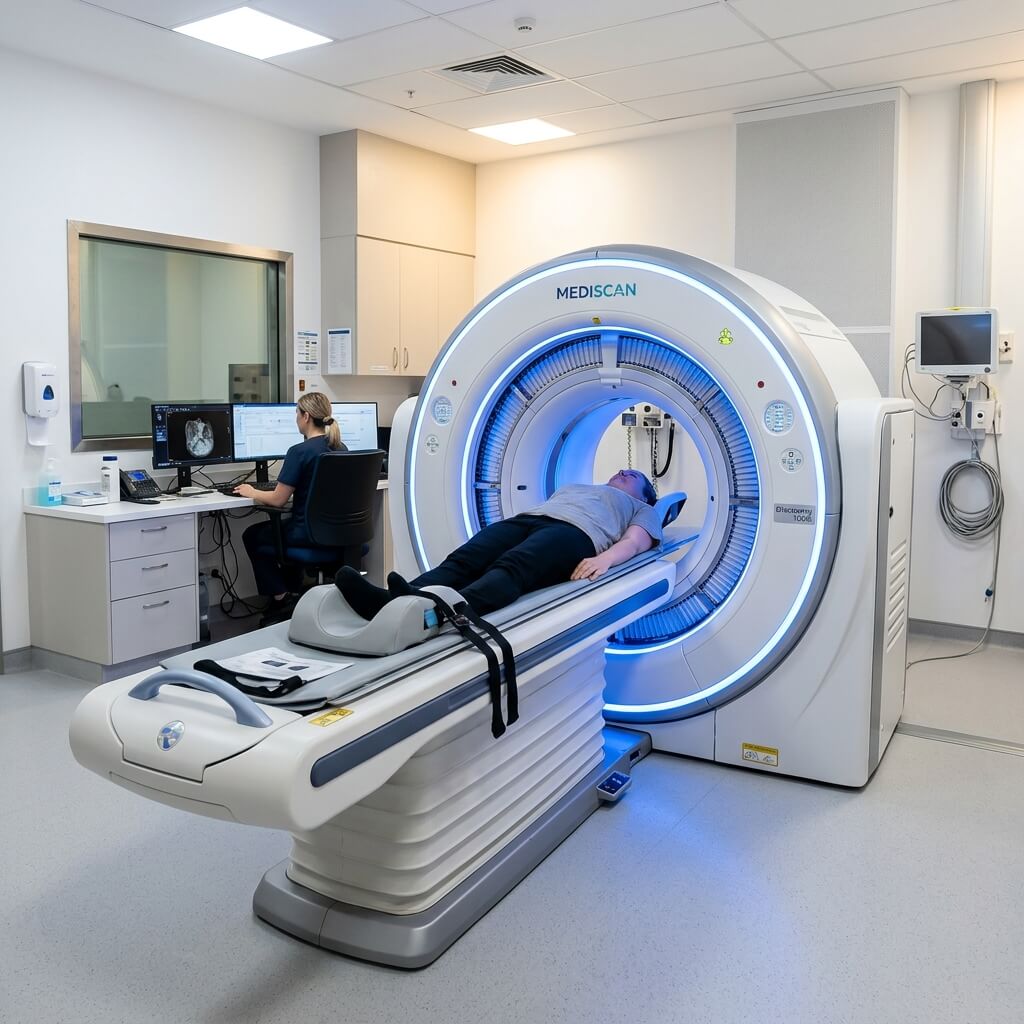
Why our digital scanner provides superior diagnostic confidence compared to conventional analog systems.
Smallest lesion detectability is feasible with the UIH Digital PET CT Scanner which comes with 1.4mm clinical resolution (2.9 mm NEMA resolution).
Smallest lesion detectability can change patient management and improve outcomes in oncological and non-oncological diseases.
Digital PET Scanners open new perspectives in the quantification and characterization of small lesions.
Shorter acquisition time / scan time significantly increases the comfort level of Geriatric & Paediatric patients.
Digital PET CT scanner reduces the radiation burden of patients, who go for oncological follow up PET CT Scans frequently.
Excellent contribution of Digital PET CT in Neurology Imaging like Dementia, Alzheimer's, Epilepsy etc.
Regional Dynamic PET CT Scan is a unique feature of UIH Digital PET CT due to higher axial FOV.
Digital PET CT scanners are ready for newer Radio Isotopes. All positron emitting radio isotopes can be used with this system.
Experience cutting-edge imaging technology designed for unmatched accuracy and patient comfort.
Detect even the smallest lesions with ultra-fine SIPM-based digital detectors for superior diagnostic confidence.
Achieve near-microscopic detail for sharper image clarity and more accurate quantification.
Crisp images, faster scans, reduced noise - powered by ultra-fast TOF for optimal patient outcomes.
Industry-leading 24 cm axial field of view and high sensitivity deliver fast, full-body imaging in just 4 bed positions.
High-sensitivity PET system enables ultra-low tracer doses without compromising image quality.
Delivers stunning CT images with fine 0.55 mm voxel sampling perfect for hybrid anatomical and functional imaging.
Deep learning trained on total-body data delivers consistently sharper, cleaner, and more natural-looking PET images.
Seamless correction of respiratory motion and metal-induced artifacts - preserving true anatomical detail.
Different radiopharmaceuticals target specific cellular receptors, helping in high-precision oncology staging.
Gold-standard whole-body metabolic imaging for oncology staging, therapy response assessment, and surveillance.
Targeted molecular imaging for prostate cancer detection, staging, and biochemical recurrence assessment.
Targeted molecular imaging for neuroendocrine tumour localization and characterization.
Advanced fibroblast activation protein imaging for selected tumour and inflammatory assessments.
Highly sensitive imaging for localizing occult insulinoma lesions.
Functional brain imaging for epilepsy, dementia, and other neurological evaluations.
Specialized dopamine pathway imaging for movement disorders and related neurological conditions.
How our Silicon PMT detector compares to classic analog photomultiplier vacuum tubes.
| Feature | Analog PET-CT | Digital PET-CT (uMI550) | Advantage |
|---|---|---|---|
| Radiation Dose | ~1 mCi / 10 kg | ~0.5 mCi / 10 kg | 50% Lower Dose |
| Scan Time | 15 - 20 minutes | 5 - 6 minutes | 3x Faster Scans |
| Spatial Resolution | ~5 - 6 mm | ~2 - 3 mm | Sharper Images |
| Detector Type | Photomultiplier Tube (PMT) | Digital Silicon Photomultiplier (SiPM) | Higher Sensitivity |
| Patient Comfort | Longer Scan Time | Shorter Scan Time | More Comfortable |
Adhering strictly to these rules is vital to ensure clear, readable molecular diagnostic scans.
Common questions regarding the clinical safety and logistics of PET-CT imaging in J&K.
Yes, it is highly safe. The radioactive tracer (such as FDG) has a short half-life (approx. 110 minutes) and leaves the body rapidly via urination. It is not a contrast dye, so allergic reactions are extremely rare. The radiation dose is minimal, especially when using our Digital uMI550 scanner, which reduces the required tracer amount by half.
While the actual scanning in our digital uMI550 scanner takes only 5-6 minutes, the entire visit takes about 2 to 2.5 hours. Upon arrival, you will receive the tracer injection and rest quietly in an uptake room for about 60 minutes, allowing the tissues to absorb the tracer, before you lie down on the scanner table.
PET-CT is generally contraindicated during pregnancy unless the diagnostic benefits heavily outweigh radiation risks. Breastfeeding mothers can undergo the scan but must express and discard milk for 24 hours post-procedure before resuming normal nursing.